FHS Covid-19 Handbook
Screening and Testing
Quarantine / Self-isolation / Isolation
GENERAL GUIDELINES FOR QUARANTINE, SELF-ISOLATION AND/OR ISOLATION
Students who are required to begin Quarantine or to start Self-Isolation/Isolation should adhere to the following national guidelines during the required Quarantine/Self-Isolation/Isolation period.
Quarantine
Quarantine is for people who are asymptomatic, but may have been in close contact* with a known positive COVID-19 patient. Quarantine keeps these people away from others so they do not spread possible infection.
Quarantine is for the following:
- Students who are asymptomatic and in close contact* with a COVID-19 positive case.
- Students who are asymptomatic who tested for COVID-19 and waiting for test results.
*Close Contact: A person having had face-to-face contact (≤1 metre) or in a closed space with a COVID-19 case for at least 15 minutes without wearing masks. This includes:
- all persons living in the same household as a COVID-19 case
- people working closely in the same environment as a COVID-19 case
- healthcare workers/clinical students providing direct care for a COVID-19 case while not wearing recommended personal protective equipment (PPE)
Self-Isolation/Isolation
Self-Isolation/Isolation is for people who are symptomatic and/or test positive for COVID-19. Self-Isolation is to isolate in one’s own Residence room or own room at home. Isolation is to isolate at a designated Wits Residence Isolation Facility or Government Isolation Facility.
Self-Isolation/Isolation is for the following:
- Students who are symptomatic for COVID-19 and are waiting to be tested, or are symptomatic and have been tested for COVID-19 and waiting for test results.
- Students who are symptomatic with mild/moderate symptoms who tested positive (severe symptoms may need to be admitted to hospital for isolation).
- Students who are asymptomatic who tested positive for COVID-19.
Number of days one needs to Quarantine/Self-Isolate/Isolate
It is important to understand the purpose of Quarantine and Isolation is to reduce the risk of transmission of COVID-19 to other people. Therefore, one is under Quarantine/Isolation for the time period one is contagious. This period is sometimes difficult to calculate accurately, with most studies indicating a person is contagious 2 days prior to symptoms and 8 days following onset of symptoms. As stated by the Health Minister, DR Zwelini Mkhize: “Asymptomatic patients represent a conceptual challenge, since it is not possible to estimate where in the course of viral shedding they are at the time point at which they test positive.”
Given current information, the NDoH has updated the De-Isolation guidelines on 17 July, 2020 as the following:
Updated De-Isolation Recommendations, 17 July 2020
- Asymptomatic student requires isolation for 10 days after their positive test date.
- Symptomatic student with mild disease requires isolation for 10 days after the onset of their symptoms (regardless of a positive test date) provided their fever has resolved and their other symptoms are improving.
- Hospitalised patients with moderate-severe disease require isolation for 10 days following achievement of clinical stability (i.e. from when they are not requiring supplemental oxygen and are otherwise clinically stable).
- Students exposed in a high-risk scenario (who are asymptomatic) start quarantine and should have a negative COVID-19 PCR test performed on day 5 and experience no symptoms before they return to campus/clinical training. If they develop symptoms, or test positive, then follow above scenarios for De-isolation.
Repeat COVID-19 PCR testing is NOT required in order to de-isolate a patient and is not recommended.

Source: Reduction in the Isolation period for patients with confirmed COVID-19 Infection
Explanation of various scenarios
Scenario A: If a student has close contact* or high risk exposure to a COVID-19 case and they are asymptomatic, they need to start quarantine for 5 days, then on day 5 be tested for COVID-19 as per the updated national guidelines (of 17 July and of Dec 2020). If the test is negative, they can end quarantine, given they remain asymptomatic and can return to campus to continue school activities. If they test positive on day 5 and remain asymptomatic, they start isolation for 10 days from test date. If they develop COVID-19 symptoms, they continue to isolate for 10 days from onset of symptoms.
Scenario B: If a student develops symptoms of COVID-19, they may meet the criteria for a PUI and be tested. They will need to self-isolate/isolate while waiting to test and/or for test results to prevent possible further transmission of the virus. If the test is negative, they can end isolation, returning to campus when symptoms resolve for other illness, to continue school activities. If they test positive, they need to isolate for a total of 10 days from onset of COVID-19 symptoms, returning to campus when symptoms resolve to continue school activities.
Scenario C: If a student is asymptomatic and tests positive for COVID-19, they need to self-isolate/isolate for 10 days from the positive test date.
There is no need to test/retest at the end of the quarantine/self-isolation/isolation period. People discharged from quarantine/isolation after 10 days should self-monitor symptoms for a further 14 days, and report development of any symptoms to Campus Health, their general practitioner, to the NICD hotline or to their local health facility.
The layouts of the Wits Residences and Hospital Nurses Residence are not all conducive to quarantine and/or self-isolating students appropriately. Where possible, students can quarantine/self-isolate in their own room if with own (non-shared) kitchen and bathroom. If not, students will be moved to a Quarantine floor in the Residence, or moved to an Isolation floor or a different building or block, subject to using separate ablution, kitchen and recreational areas (i.e. common areas). Students must be able to meet the criteria of quarantine/self-isolation, if this is not possible, the student will be moved to a different residence/facility that meets the isolation criteria.
Wits FHS has a level of responsibility to oversee and monitor those students who may test positive for COVID-19 in Wits Residences.
CATEGORIES OF QUARANTINE/ISOLATION FOR WITS STUDENTS
The table below describes four categories of Wits students (who either live at a Wits Residence, Hospital Nurses Residence, non-Wits Private Residence or at home) and the ability for a student to quarantine, self-isolate or isolate in their current living situation, or if arrangements need to be taken to relocate. Steps are provided after the table for students to follow should they need to relocate from their current living situation to quarantine, self-isolate or isolate properly to follow the national guidelines.
|
Student Living situation |
Steps for Quarantine |
Steps for Self-Isolation/Isolation |
|
1. Wits Student who resides at Wits Residence |
1a. Student can Quarantine in own Wits Res room if with own self-cater kitchen and self-contained bathroom. Student stays in own room. |
1c. Student can Self-Isolate in own Wits Res room if with own self-cater kitchen and self-contained bathroom. Student stays in own room. |
|
1b. Student to move to a Quarantine area or floor in their Wits Res if Res with shared kitchen/bathrooms. Or Student moves to a different Wits Res set up for Quarantine. |
1d. Student to move to a Wits Res Isolation Block if room without own kitchen/ bathroom. Student to be transported & relocated to new Res by Wits. |
|
|
2. Wits Student who resides at Hospital Residence (e.g. Witwaters Nurses Res, CHBAH Nurses Res) |
2a. Student can not Quarantine own room because of shared facilities. Student to move to Quarantine area or floor in the Hospital Nurses Res (if available) |
2c. Student to Isolate in a Government Isolation Facility for HCW/clinical students. Student to be transported & relocated to Isolation Facility by Wits. |
|
2b. If Quarantine floor not available, Student to move to a Government Quarantine Facility for Healthcare workers/clinical students. Student to be transported & relocated to Quarantine Facility by Wits. |
2d. Student to Self-Isolate in Wits Res Isolation Block if space available with motivation for acceptance, and make full payment for Wits Res costs. |
|
|
3. Wits Student who resides at non-Wits Private Residence (e.g. South Point, Digz) |
3a. Student can not Quarantine own room because of shared facilities. Student to move to Quarantine floor in the non-Wits Private Res (if available) |
3c. Student to Isolate in a Government Isolation Facility for public. Student to self-transport & relocate to Isolation Facility |
|
3b. Student to move to a Government Quarantine Facility for public. Student to self-transport & relocate to Quarantine Facility. |
3d. Student to Self-Isolate in Wits Res Isolation Block if space available with motivation for acceptance, and make full payment for Wits Res costs. |
|
|
4. Wits Student who resides at home, private residence |
4a. Student to Quarantine in own room at own home (if meet criteria) |
4c. Student to Self-Isolate in own room at own home (if meet criteria) |
|
4b. Student to move to a Government Quarantine Facility for public. Student to self-transport & relocate to Quarantine Facility. |
4d. Student to Isolate in Government Isolation Facility for public. Student to self-transport & relocate to Isolation Facility. |
|
|
4e. Student to Self-Isolate in Wits Res Isolation Block if space available with motivation for acceptance, and make full payment for Wits Res costs.
|
Any Student can move home for Quarantine or Self-Isolation in any situation above if applicable. Provide own transportation.
STEPS TO FOLLOW FOR NEED TO QUARANTINE/ISOLATE IN RESIDENCE
1
- Student to begin quarantine/self-isolation/isolation as soon as possible.
- Any student who needs to start quarantine/self-isolation/isolation to contact their Course Coordinator, if not done so already to inform of the following:
- to be contactable by mobile phone and email at all times during their period of quarantine/isolation.
- to check-in with their Course Coordinator/Residence Manager twice a week.
- To declare any relevant co-morbidities to a Wits-designated clinician, to allow identification as vulnerable to more severe COVID-19 disease.
- To provide details of any health care practitioner involved in their care, allowing a Wits-designated clinician contact as necessary.
- To self-monitor for the development and/or worsening of symptoms, with special vigilance concerning possible progression of the disease.
3. Students to contact their Wits Residence Cluster Manager/Warden, or Hospital Nurses Residence Manager, or non-Wits Private Residence Manager to organise/verify for student to remain in current room, or if necessary for student to be relocated to another room available in a Quarantine Floor, or move to Isolation area of Residence or relocate to a Government Isolation Facility as needed. (See table above)
4.
- For Wits Residence Students in quarantine or self-isolation:
- Course Coordinator to contact Mr Nazime Randera, Assistant Registrar, Campus Housing and Residence Life at Nazime.randera@wits.ac.za who will inform Cluster/Res Manager
- Cluster manager will allocate a room appropriate for student situation (See table above)
- Res Manager to organise transport for student to travel from current location to designated Isolation location if necessary. (Wits transport service to be identified)
- Res Manager/student to inform Campus Health and Wellness Centre (CHWC) and Sister Maggie about the case and contact will be made with the student. Email Anna.Moloi@wits.ac.za
- The student will update CHWC for any changes in their health condition, i.e. worsening of symptoms, if any
- Thereafter, contact should be made by telephone to ensure quick response
- If a catered students, the student may continue booking meals and such will be delivered daily and placed at the door of the room. Student will be alerted to delivery of meals.
- If Self-catering, student will be allocated to a self-catering room with cooking facilities. Student may be provided with food parcels by the cluster manager or apply for Care Kit food parcel from OSS, email Makeadifference.health@wits.ac.za
- If need to be relocated to new room and within walking distance, a student will be encouraged to take basic necessities to walk to the new room
- If new room is of greater distance, transport will be arranged
- The quarantined student will be checked telephonically daily to establish possible needs they may have
- Student will be provided with cleaning material for the duration of their stay
- Student will be given time out of the Quarantine/Self-Isolation site if they have to go conduct further tests, otherwise students are to remain in their designated room
- All students to follow Quarantine/Self-isolation checklist when in their rooms as described below
CHECKLIST FOR QUARANTINE/SELF-ISOLATION/ISOLATION AT RESIDENCE OR HOME
- You should Quarantine/Self-Isolate/Isolate yourself at residence or home for number of days as described in guidelines.
- Quarantine/Self-Isolate/Isolate yourself in a separate, well-ventilated room at residence or home.
- Don’t go to school, campus, clinical sites or work. Do not leave you residence or home, unless for medical reasons.
- Avoid unnecessary travel outside your residence or home, and as far as possible avoid close interactions with other people.
- Visitors are not be allowed until you have completely recovered from signs and symptoms.
- You should clean your hands with soap and water frequently. Alcohol-based sanitizers may also be used, provided they contain at least 60% alcohol.
- Hand hygiene should also be performed before and after preparing food, before eating, after using the toilet, and whenever hands look dirty.
- Do not have visitors in your room at home/residence. Only those who live in your home should be allowed to stay. If it is urgent to speak to someone who is not a member of your household, do this over the phone.
- At home, you should stay in a specific room and use your own bathroom (if possible). If you live in shared accommodation (university residence or similar) with a communal kitchen, bathroom(s) and living area, you should stay in your room with the door closed, only coming out when necessary, if in self-isolation with symptoms, you should wear a surgical mask when using communal areas.
- If in self-isolation, with symptoms and others are in close proximity to you (due to necessity only, when in the same room, when using a shared bathroom/kitchen area), please ensure that you are wearing a surgical mask that is fitted tightly around your nose and mouth. The mask should be used when you are near other people until your symptoms have resolved or you have been informed by your doctor as such.
- You should practice good cough and sneeze hygiene by coughing or sneezing into a tissue, discarding the tissue immediately afterwards in a lined trash can, and then wash your hands immediately.
- Household/residence members should stay in a separate room/s from the suspected case. If this is not possible, a minimum distance of 1.5 to 2 meters should be maintained at all times. If you are symptomatic and need assistance, limit the number of caregivers. Ideally assign one person who is in a good health without underlying chronic conditions or immunocompromised conditions.
- The caregiver should wear a tightly fitted medical mask that covers his/her mouth and nose when in the same room with the patient. Masks should not be touched or handled during use. If the mask gets wet or dirty with secretions, it must be replaced immediately with a new, clean, dry mask. Remove the mask by using an appropriate technique (i.e. do not touch the front but remove the lace from behind). The surgical mask can be reused if not soiled, wet or degraded. Following mask removal, perform hand hygiene.
- Wash laundry at the highest temperature compatible for the fabric using laundry detergent. This should be above 60° C. If possible, tumble dry and iron using the highest setting compatible with the fabric. Wear disposable gloves and a plastic apron when handling soiled materials if possible and clean all surfaces and the area around the washing machine. Do not take laundry to a laundrette. Wash your hands thoroughly with soap and water after handling dirty laundry (remove gloves first if used).
- You should avoid sharing household items like dishes, cups, eating utensils and towels. After using any of these, the items should be thoroughly washed with soap and water.
- All high-touch surfaces like table tops, counters, toilets, phones, computers, etc. that you may have touched should be appropriately and frequently cleaned.
- Clean and disinfect frequently touched objects and surfaces with soap and water followed by 60% alcohol or bleach containing solution.
- Clean and disinfect bathroom and toilet surfaces at least once daily. Regular household soap or detergent should be used for cleaning and then, regular household disinfectant should be applied to these surfaces.
- Monitor your symptoms, take your temperature daily - Seek prompt medical attention if you develop symptoms or if currently with symptoms and they worsen. For example, if you have fever, cough, sore throat and/or difficulty breathing, then call your doctor, healthcare facility or Campus Health and or call the NICD Hotline to inform them of changes to your condition.
- Campus Health and Wellness Centre on Education Campus is 011 717 9113
- Campus Health and Wellness Centre on Main Campus 011 717 9111
- NICD HOTLINE is 0800 029 999
- If it is an emergency and you need to call an ambulance, inform the call handler or operator that you are being quarantined/ isolated for SARS-CoV-2.
- Ambulance is 10177 from landline or 112 from mobile phone
More information on Quarantine/Isolation: What to do if I test positive for coronavirus disease and I am asked to isolate?
Categories of people and quarantine/isolation recommendations per national guidelines, updated 13 July 2020
|
Category |
Quarantine |
Isolation |
|
Student asymptomatic with close contact* to positive COVID-19 person without social distancing |
Quarantine at home/Res for 10 days. If not possible, admit to a quarantine facility. If PUI and test neg, end quarantine. |
If test positive, start isolation, follow below |
|
Clinical student close contact to positive COVID-19 patient without proper PPE |
Quarantine at home/Res. If not possible, admit to a quarantine facility. If well, test on day 5 and if result is negative return to campus/school |
If test positive, start isolation, follow below |
|
Student with symptoms who meets PUI criteria, waiting test result |
Quarantine at home/Res for 10 days from onset of symptoms. If not possible, admit to quarantine facility. Can be released from quarantine if test result is negative. |
If test is positive, start Isolation, follow below |
|
Student asymptomatic who test positive for COVID-19 |
If test positive, student need to Self-Isolate/Isolate |
Self-Isolate at home/Res for 10 days from positive test date. If unable to self-isolate at home/Res, admit to isolation facility |
|
Student with mild symptoms who test positive for COVID-19 |
If test positive, student need to Self-Isolate/Isolate |
Self-Isolate at home/Res for 10 days from onset of symptoms. If unable to self-isolate at home/Res, admit to isolation facility |
|
Student who test positive for COVID-19 has been admitted to hospital |
If test positive, student need to Self-Isolate/Isolate |
Isolate at hospital. De-isolate 10 days after clinically stable (not requiring oxygen) or 10 days after onset of symptoms (if did not require oxygen) |
Source: Updated NDOH De-Isolation Guidelines as of 13 July, 2020
Source: NDOH Guidelines for Quarantine and Isolation COVID-19
Click here for more information on Quarantine/Isolation
FHS+PT+Bronchial+Hygiene+and+Exercies+during+Quarantine+_+Isolation+in+COVID19
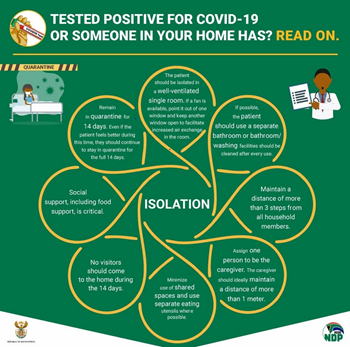
Click here for further information on Home Isolation from SA Coronavirus website